External wall corners fail differently from flat wall areas. A flat render panel cracks along the surface; a corner cracks because the edge itself is the weakest, most exposed, and most dimensionally active part of the wall. That is exactly the problem a plaster corner bead — also called an angle bead — is designed to control.
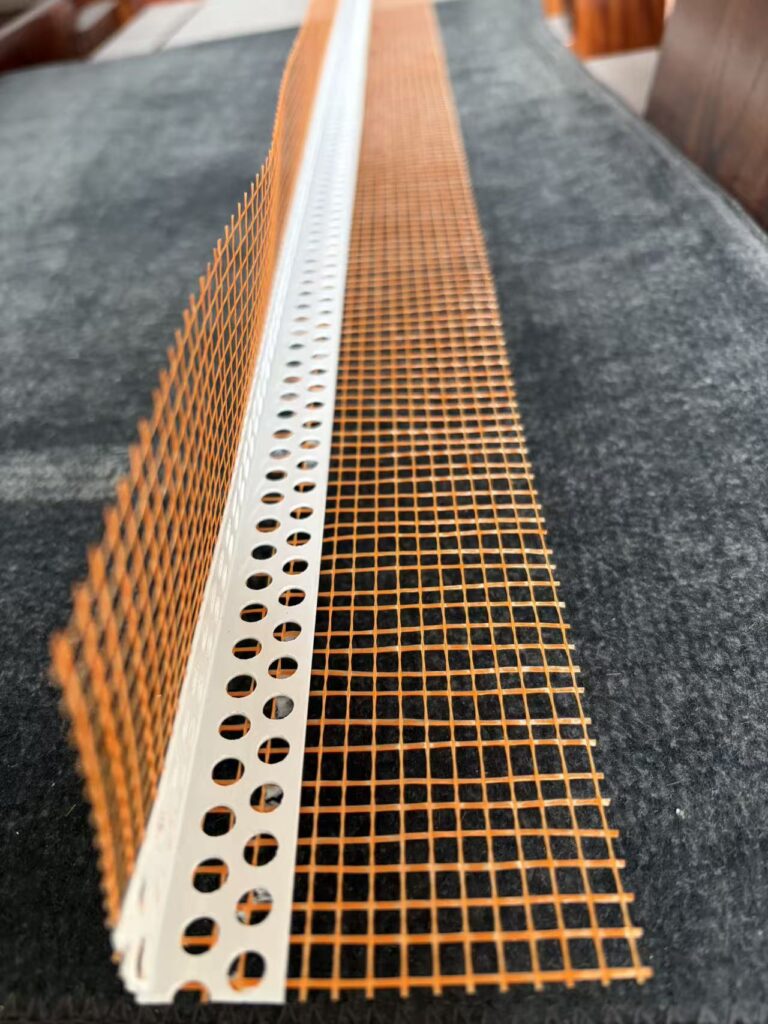
A corner bead is not a decorative trim. It is a reinforcement accessory that performs three jobs at the same time: it forms a true, straight arris; it protects the corner against mechanical impact; and its mesh wings tie the corner zone into the reinforced render layer so that movement is distributed rather than concentrated along the edge. When the bead and the field mesh are specified as a matched pair, the corner becomes part of the reinforced system. When they are mismatched — wrong material, wrong wing, wrong fixing — the bead becomes the starting point of the crack it was supposed to prevent.
At Yuechen Insulation Building Materials, we are a direct manufacturer of alkali-resistant fiberglass mesh. We also supply matching PVC plaster corner beads for ETICS and external render systems. With years serving insulation contractors and wholesale buyers across the UAE, Malaysia, Indonesia, Thailand, the UK and Southeast Asia, we know exactly which mistakes lead to corner cracking on site.
The Material Decision Comes Before the Specification
The most consequential choice in external rendering is not the wing width. It is the bead material, because external render exposes the bead to moisture, salts, and cement alkalinity that interior plaster never applies.
Galvanised steel is not an external product. Industry installation guidance states plainly that mild steel galvanised to Z275 is not suitable for external applications, and that stainless steel should be used externally with cement-based renders. Manufacturer literature for galvanised beads goes further: they are “not suitable for external applications unless secondary protection against corrosion is provided,” and they are not resistant to corrosion where the finishing coat is less than 3 mm in exterior areas. The zinc coating is a sacrificial layer; once moisture and chloride exposure consume it, the steel substrate corrodes and expands, pushing the render away from the arris. That expansion is a direct, predictable cause of edge cracking and spalling.
Stainless steel is the default recommendation for external render and high-exposure conditions, including coastal areas. It is the correct choice where the bead is expected to remain fully embedded in a cementitious system for the life of the façade.
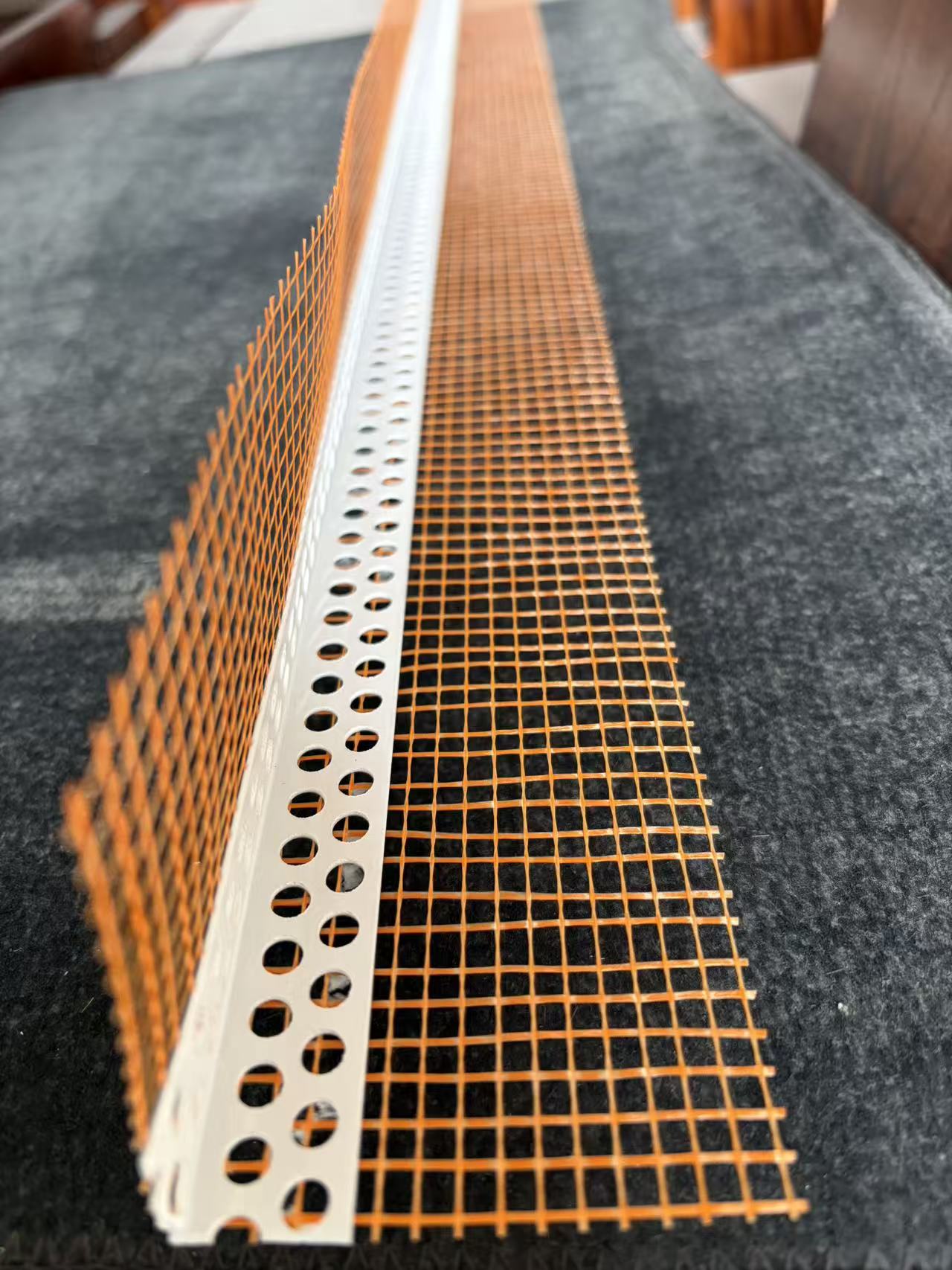
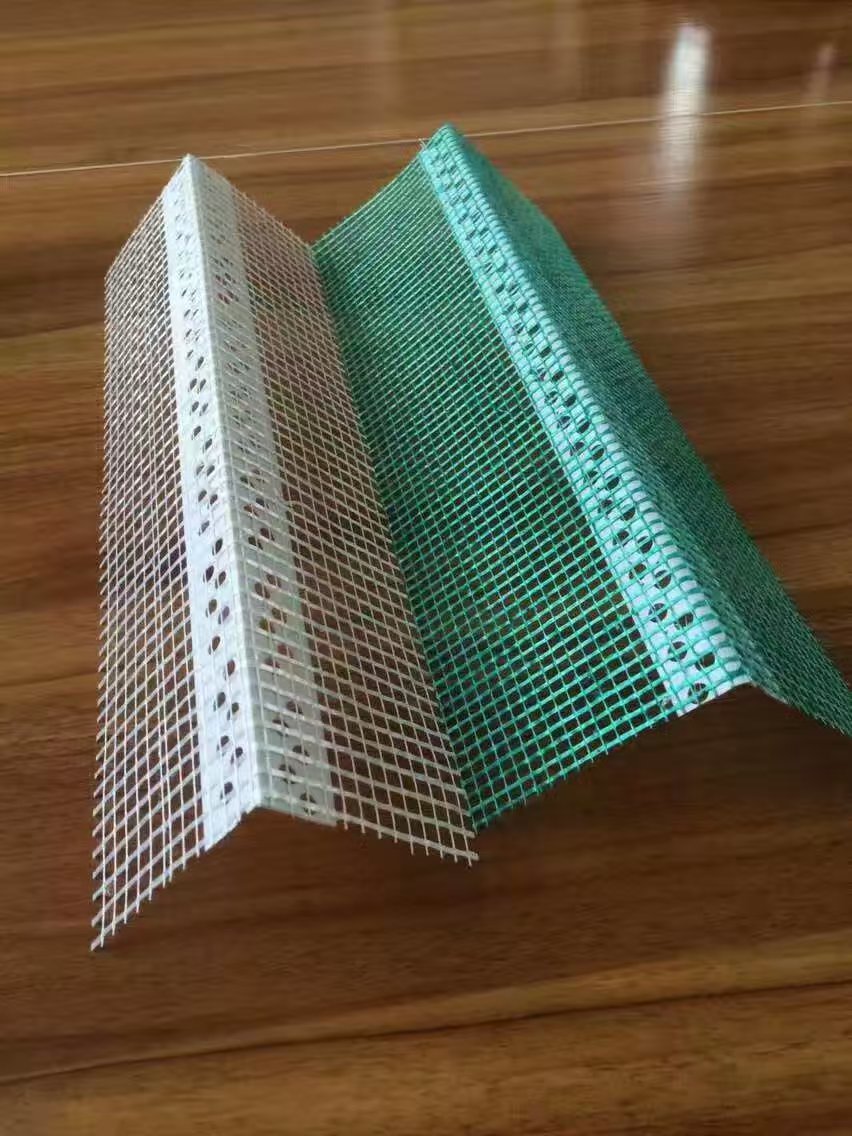
PVC plaster corner bead with AR mesh is the practical external solution where the goal is a non-corroding, lightweight, and cost-stable profile. Exterior-grade PVCu beads are formulated for impact resistance and UV stability, and are used across external rendering and external wall insulation systems. PVC does not rust, does not set up a galvanic couple with the render, and does not depend on a zinc coating surviving site handling. For volume wholesale and EWI/ETICS applications, it is the material that makes the bead-and-mesh system repeatable across thousands of linear meters.
A useful rule for buyers: if the project is a cement-based external render and the bead is galvanised steel, ask what secondary corrosion protection is being provided. If the answer is “none,” the material is wrong for the exposure.
Why the Mesh Wing Matters More Than the Nose
The visible nose of a corner bead is what the trowel runs against. The mesh wing is what makes the bead part of the reinforcement system. In external rendering, the wings are embedded into the render or basecoat and must overlap the adjacent field reinforcement. System guidance commonly requires mesh joints to overlap by not less than 100 mm. If the bead wing is too narrow to achieve that overlap, the corner becomes an unreinforced seam regardless of how straight the arris looks on day one.
This is why wing width cannot be selected from a catalogue in isolation. It has to be checked against two project variables: the specified render or basecoat thickness, and the width and position of the field mesh. A bead with a 40–50 mm wing may be adequate for a thin decorative render where it can still catch the field mesh. A thicker basecoat or a system with an offset field mesh may require a wider wing or a different fixing detail. The purchasing question is not “what is your widest wing?” but “does this wing achieve the specified overlap with the field mesh at the project’s render depth?”
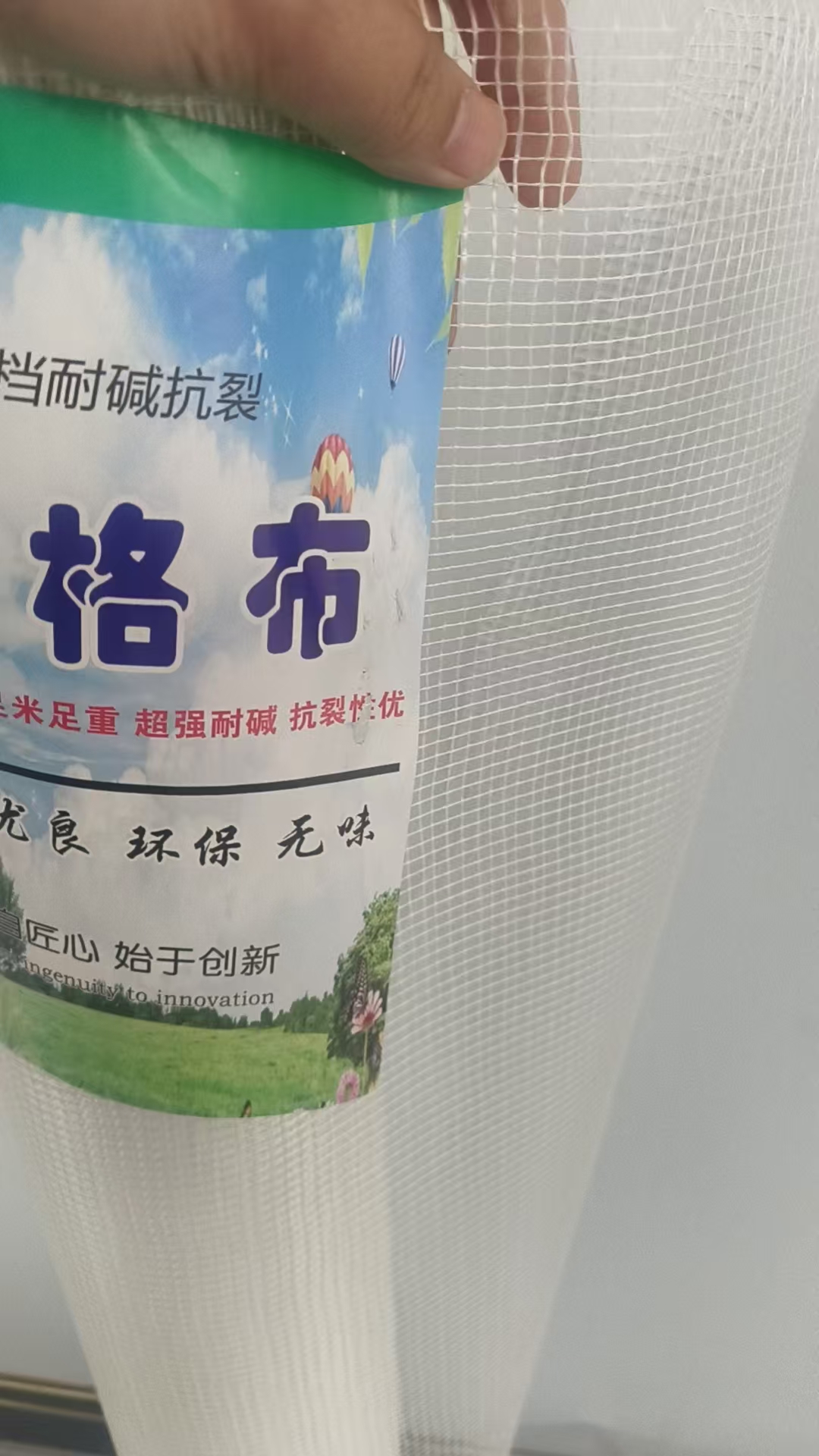
The mesh itself carries a parallel specification. Alkali-resistant coating is a functional requirement, not an upgrade: untreated glass fibre degrades in the alkaline environment of cement and lime, while AR-treated mesh retains tensile strength over time. For external wall insulation and basecoat reinforcement, 145 gsm is the common standard-ETICS weight, while 160 gsm is used for heavy-duty or high-stress areas. Where the corner is treated as a distinct reinforcement zone, some EIFS specifications call for corner mesh at not less than 244 g/m² (7.2 oz/yd²). The bead wing and the field mesh should come from the same reinforcement logic — otherwise the corner and the field behave as two different systems.
Installation Variables That Decide Whether the Corner Cracks
A correctly specified bead can still fail at the fixing stage. Three variables matter most in external work.
Fixing centres. Traditional plaster-dab fixing places dabs at approximately 600 mm centres on both sides of the arris. For external render and high-impact areas, mechanical fixing at 300 mm centres is recommended, while internal work typically uses 450 mm centres. In exposure conditions, the closer spacing is not over-specification; it prevents the bead from rocking or bowing as the render shrinks.
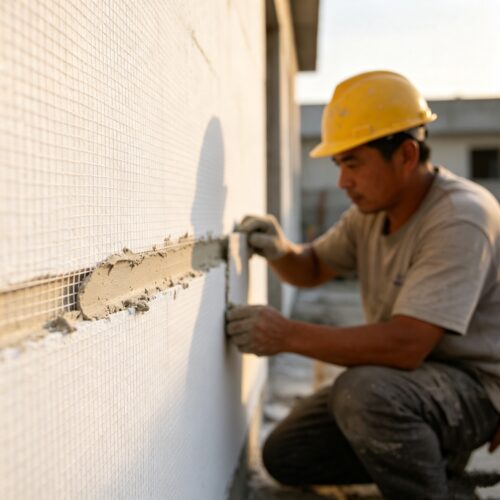
Embedment, not surface contact. The wings must be pressed into the wet basecoat or render so that the mesh is fully wetted and free of wrinkles, then covered by the next pass. A wing that sits on the surface rather than in the matrix provides no reinforcement and creates a plane of weakness.
Overlap discipline at corners and openings. Reinforcing mesh should be continuous around corners, with overlaps at joints of at least 100 mm where the system specifies it. Where the bead is used at openings, diagonal reinforcing patches at window and door corners are a standard detail because that is where concentrated stress initiates cracking. The bead protects the arris; the diagonal patch protects the opening corner. They solve different failure modes and should not be substituted for each other.
What Actually Causes Cracking at External Corners
Corner cracking is usually attributed to “render shrinkage,” but in practice the causes cluster into four categories:
Corroding metal bead. Galvanised steel in a damp external environment loses its zinc protection over time and the substrate corrosion expands under the render. This is a material-selection failure, not a workmanship failure.
Insufficient fixing. Dabs too far apart or mechanical fixings omitted allow the bead to move independently of the substrate during curing and thermal cycling.
Mesh discontinuity. Wing overlap below the specified minimum, or field mesh butted rather than lapped at the bead, leaves the corner unreinforced even though a bead is present.
Bead/render thickness mismatch. A bead designed for a thicker render sits proud of a thin coat, creating a ridge that catches impact and concentrates stress; a bead too small for the render depth disappears and loses its arris definition.
PVC with alkali-resistant mesh wings addresses category 1 structurally, but categories 2–4 remain installation and specification controls. That is why a bead is only as good as the overlap and fixing schedule it is installed to.
A Specification Checklist for Wholesale and Project Buyers
Before ordering, convert the wall detail into a short purchase schedule. This is the most reliable way to avoid a bead that looks correct in a catalogue but fails on site.
Substrate and system: Confirm whether the render is cement-based, lime-based, or an EIFS basecoat. A bead labelled for drywall or internal plaster should not be assumed suitable for a cementitious exterior render.
Material: PVC with AR mesh for non-corroding external use; stainless steel where a metal profile is required. Galvanised steel only with verified secondary corrosion protection — and generally not for damp external exposure.
Wing width and mesh weight: State the required overlap to the field mesh (typically ≥100 mm at joints) and the field mesh weight (145 gsm standard ETICS, 160 gsm heavy-duty). Confirm the wing can achieve that overlap at the specified render depth.
Length, profile, and tolerance: Standard lengths vary (1.9 m, 2.5 m, 3.0 m are common); confirm the length suits the reveals and that the profile is 90-degree with the required nose height. Ask for straightness and wing-attachment tolerances, not just nominal dimensions.
Sample before bulk: Embed a sample in the actual basecoat at the planned depth. Check that the mesh wets through, lies flat, and overlaps the field reinforcement as intended. Retain the approved sample against incoming lots.
Traceability and packing: Confirm pieces per carton, lot identification, and packing that protects the nose and mesh attachment during transport.
Why Bead and Mesh Should Be Supplied Together
The corner reinforcement is a two-part system:the plaster corner bead provides the arris and the wing; the field mesh provides the continuity of reinforcement. When they are bought from separate sources, the risk is not usually a visible dimensional error — it is a hidden mismatch in mesh weight, coating, or overlap geometry that only appears after the first heating and cooling cycle.